Quartz vs. Granite vs. Butcher Block Countertops
An honest comparison of quartz, granite, quartzite, marble and butcher block for a Southlake kitchen remodel: durability, maintenance, cost drivers and where each one fails.
Countertops are the second-largest material line in a kitchen remodel and the one homeowners research the hardest. Most of that research turns into a preference before anyone has explained how these surfaces actually behave in a working kitchen.
Quartz
Engineered stone: roughly 90% ground quartz bound with resin and pigment.
Good: Non-porous, so it never needs sealing and does not stain from wine, coffee or oil. Consistent pattern, which means the slab you approve is the counter you get. Huge range of looks, including convincing marble veining.
Bad: Heat sensitive. The resin can scorch or discolor under a hot pan. Use trivets, and be careful next to a range. Prolonged direct sunlight can yellow some products, which matters in kitchens with big west-facing windows.
Verdict: The default recommendation for most Southlake kitchens, and it is not a compromise choice. If you want marble's look without marble's maintenance, this is how you get it.
Granite
Natural stone, quarried and cut into slabs.
Good: Genuinely heat resistant. You can set a hot pan on it. Every slab is unique. Very hard and durable. Often less expensive than comparable quartz in mid-range colors.
Bad: Porous, so it needs sealing, typically once a year. Unsealed granite will stain from oil. The variation that makes it interesting also means you must approve your actual slab at the yard, not a sample chip. The busy speckled granites of the 2000s date a kitchen quickly; the current-looking granites are the quieter, more linear ones.
Verdict: Still an excellent counter, and unfairly out of fashion. If you cook hard and hate maintenance rules about hot pans, granite deserves a look.
Quartzite
Natural stone, frequently confused with quartz. Completely different material.
Good: Harder than granite, heat resistant, and the marble-like ones (Taj Mahal, Macaubas) are genuinely beautiful.
Bad: Expensive. Porous, so it needs sealing. Some slabs sold as quartzite are actually softer dolomitic marble, which etches. Ask the fabricator to confirm what you are buying.
Marble
Good: Nothing else looks like it. Naturally cool, which is why bakers love it.
Bad: It etches. Lemon juice, vinegar and wine will dull the polish, and no sealer prevents this. Sealers stop staining, not etching. It scratches and chips at the edges.
Verdict: Choose marble only if you genuinely like patina, or put it on an island or baking station and use something tougher around the range and sink. Plenty of people love their marble. Nobody is neutral about it.
Butcher block
Good: Warm, comparatively inexpensive, sandable and refinishable. Good on an island or a coffee bar as a contrast to stone.
Bad: Needs oiling. Poor choice around a sink unless sealed carefully and maintained. Burns and cuts.
Verdict: Excellent as an accent. Rough as an entire kitchen unless you actively want the upkeep.
What each material costs
Installed, per square foot, as Southlake planning estimates. Fabrication and edge work are included in these; waterfalls and slab backsplashes are not.
| Material | Installed / sq ft | Sealing | Heat |
|---|---|---|---|
| Laminate | $25 to $50 | Never | Poor |
| Butcher block | $40 to $75 | Oil periodically | Poor |
| Granite | $50 to $110 | ~Annually | Excellent |
| Quartz | $60 to $130 | Never | Fair, use trivets |
| Quartzite | $80 to $180 | ~Annually | Excellent |
| Marble | $75 to $200+ | ~Annually | Good, but etches |
A typical Southlake kitchen with a large island runs 55 to 90 square feet of surface, so a $20/sq ft difference in material is a $1,100 to $1,800 swing, usually smaller than what the edge profile and backsplash decisions add.
Cost drivers that have nothing to do with material
Two kitchens can pick the same quartz and get quotes $6,000 apart. Here is why:
- Edge profile. A standard eased edge is included. Mitered edges that make a 2" or 3" thick look require the fabricator to cut, glue and polish a return, which is real labor.
- Waterfall island sides. Doubles the material on the island and requires a matched vein wrap.
- Full-height backsplash. A slab backsplash instead of tile costs more but looks continuous and never needs grout cleaned.
- Seams. A large island that exceeds slab dimensions needs either a seam or a jumbo slab. Jumbo costs more.
- Cutouts. Undermount sinks, cooktops and pop-up outlets are each priced separately.
Choosing without regret
- Match the counter to how you cook. Hot pans and no patience for rules → granite or quartzite. Kids and spills → quartz. Baking and patina → marble.
- See the actual slab for anything natural. Photos lie about scale; a vein that looks subtle in a 4" sample can dominate an island.
- View samples in your kitchen's light, next to your cabinet door, at the time of day you use the room. Showroom lighting flatters everything.
- Decide the edge and backsplash early: they are quoted separately and are where the surprise cost lives.
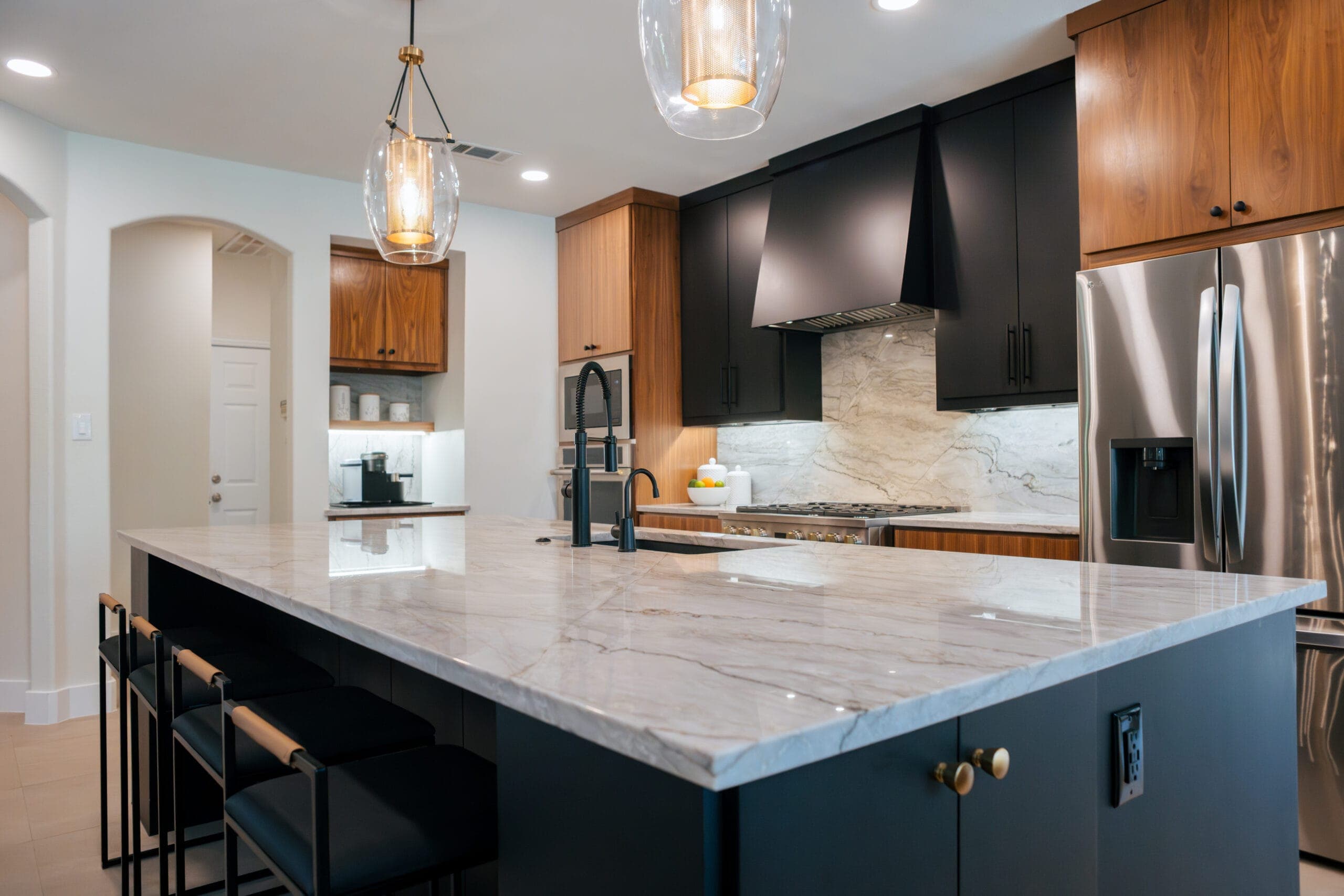
For a Southlake kitchen remodel with a big island and an open plan, quartz in a soft veined pattern with a mitered edge is the combination local fabricators report installing most, and it holds up.
Frequently asked questions
Is quartz better than granite?
Neither is better outright. Quartz is engineered and non-porous, so it never needs sealing and will not stain, but the resin binder can scorch under a hot pan. Granite is natural stone that genuinely resists heat but is porous and needs sealing about once a year. Choose by how you cook: hot pans and no patience for maintenance rules favors granite; kids and spills favors quartz.
Does quartz stain or scratch?
Quartz does not stain, because it is non-porous. Wine, coffee and oil wipe off. It scratches less readily than most surfaces but is not scratch-proof, and its real weakness is heat: a pan straight off the burner can leave a permanent mark. Prolonged direct sunlight can also yellow some products, which matters in kitchens with large west-facing windows.
What is the difference between quartz and quartzite?
Quartz is engineered: roughly 90% ground stone bound with resin. Quartzite is natural stone, harder than granite and heat resistant, but porous and more expensive. They are frequently confused, and some slabs sold as quartzite are actually softer dolomitic marble that will etch. Ask the fabricator to confirm what you are buying.
Do granite countertops need to be sealed?
Yes, typically once a year. Unsealed granite absorbs oil and will stain. Testing is simple: leave a few drops of water on the surface for fifteen minutes; if it darkens, it is time to reseal.
Why do two quotes for the same material differ by thousands?
Fabrication, not stone. A standard eased edge is included; a mitered edge that creates a thick two- or three-inch look requires cutting, gluing and polishing a return. Waterfall island sides double the material and require vein matching. A full-height slab backsplash costs more than tile. Seams, jumbo slabs and each cutout are priced separately.
Is marble a bad idea in a kitchen?
Only if you dislike patina. Marble etches from anything acidic and no sealer prevents it, and it chips at the edges. Plenty of people love their marble anyway. A common compromise is marble on an island or baking station with something tougher around the range and sink.
Related posts
- Materials
Choosing Kitchen Cabinets: Shaker, Slab, and Inset
Door styles, construction quality, and finishes for a Southlake kitchen remodel, and what the price difference between overlay and inset cabinets actually buys you.
- Hiring & Permits
Why Not to Hire a Chuck in a Truck for Your Kitchen Remodel
What goes wrong when you hire the cheapest or least experienced contractor for a Southlake kitchen remodel: no insurance, no permits, liens, lost deposits and work that has to be redone.
- Layouts & Ideas
What It Costs to Remodel a Galley Kitchen in Southlake
Southlake estimates for remodeling a galley kitchen, from a cosmetic refresh to opening a wall, plus the layout rules that make a narrow kitchen cook like a big one.